Finback
Mariners' Museum, Uncurated Search Results
Type: Bugeye
Year: 1873
Builder:
Location: Crisfield

These records are found in the online catalog of The Mariners’ Museum and Park in Newport News, Virginia. Uncurated search results are presented to give researchers and interested readers an idea of whether the museum’s archives contain information about this vessel and whether it may be worthwhile to visit the museum’s catalog search page for further investigation. Uncurated results may be inaccurate or incomplete.
Search mode: Exact Name. Search phrase(s): "Finback". Results returned: 14. Results displayed in this table: 14.
Use these buttons to send uncurated search results to your own app or text document for further research. First, check the box for any row, or click "Select All" then uncheck any rows. Then click "Show Selections". You can then copy your selections from the text box and past them into your app.
| Fetch? | Row ID | Media | Date | Vessel | Place | Related Places | Inscription/Marks | Subject | Notes | Archive Number |
|---|---|---|---|---|---|---|---|---|---|---|
| 1 | No image URL. | Finback (Nuclear submarine : SSN-670); United States. Navy | Nuclear submarines. | Finback joins the fleet | LB99125 | |||||
| 2 | No image URL. | 1968-1970 | Newport News Shipbuilding and Dry Dock Company.; Finback (Submarine (nuclear powered) : SSN-670). | Ships–Launching.; Submarines (Ships)–United States.; Warships–History–20th century. United States; Naval ceremonies, honors and salutes–Virginia–Newport News. | Three recordings of the launching and commissioning of USS Finback (SSN-670), Hull #582. | MS0809/01.02-02.15 | ||||
| 3 | 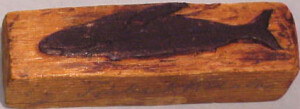 | SHORT DESCRIPTION: Wooden whale stamp, bearing raised relief of finback whale. Marked in pencil on side "Finback Whale." NOTES: Nantucket native William F. Macy learned the printer’s trade at Nantucket’s newspaper, ‘The Inquirer and Mirror.’ After going to the mainland he worked in several printing shops around Boston and was appointed as the first instructor in printing at the Lyman School for Boys in Westboro, Massachusetts. Later Macy opened an insurance agency in Boston. Throughout this time he continued studying Nantucket history and frequently contributed articles to ‘The Inquirer and Mirror’ (signing his articles "Yorick"). Around 1912, in collaboration with Anna Gardner Fish and Roland Bunker Hussey, Macy issued the first edition of the "Nantucket Scrap Basket". He arranged for a second edition of this publication in 1932. In 1915, Mr. Macy prepared and published "The Story of Old Nantucket," a condensed history of Nantucket (reprinted in 1931). He was a founder and one time president of "The Sons and Daughters of Nantucket." In 1924, Macy was appointed President of the Nantucket Historical Association and served until his death in 1935. During this time Edward F. Sanderson approached the Association about receiving his collection of whaling paraphernalia with the purpose of establishing a whaling museum on Nantucket. When he returned to Nantucket in 1928 Mr. Macy purchased the old American House property, on the corner of Orange Street and Martins Lane, and built the house now standing there. This became Macy’s headquarters during his decade of planning, raising money and finally establishing the Nantucket Whaling Museum which opened its doors on July 24, 1930. | CL2345 | |||||||
| 4 | No image URL. | Finback (Submarine (nuclear powered) : SSN-670).; United States. Navy. | Ships–Launching.; Nuclear submarines. | Nuclear attack submarine is christened Finback | LB99215 | |||||
| 5 | No image URL. | Smithsonian miscellaneous collections. Washington, 1903 (25 cm.) ; v. 45, p. 91-94, pl. 24-26. | Whales.; Photography of animals | Publication 1423. Vol. 45 (Quarterly issue, v. 1) with t.-p. dated 1903, was issued 4 parts in 2, with covers dated 1904. | LB22978 | |||||
| 6 | No image URL. | Finback (Submarine (nuclear powered) : SSN-670). | Contains black-and-white photographs. | MS0817/01-03.186 | ||||||
| 7 | No image URL. | Finback whale. | Caption title. From Proceedings of the Royal Society of Edinburgh, session 1869- 1870. | LB35289 | ||||||
| 8 | No image URL. | Finback whale–Anatomy | "From the Proceedings of the Zoological Society of London, February 14, 1865." | LB35292 | ||||||
| 9 | 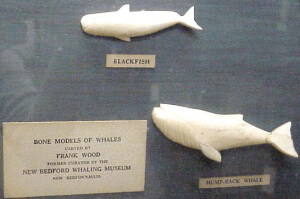 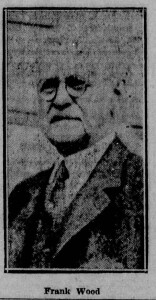 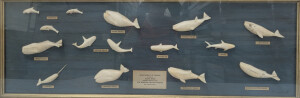 | SHORT DESCRIPTION: Plaque of carved ivory whales made by Frank Wood (1851-1933), the former Curator of the New Bedford Museum. NOTES: In 1914, the Old Dartmouth Historical Society appointed Frank Wood as the curator and first full-time staff member. The 1925 book 'Whale Ships and Whaling, A Pictorial history of Whaling During Three Centuries...' states that wood was the curator of the Bourne Whaling Museum of New Bedford. Bourne was the name of the large museum building that housed New Bedford's collection. In 1926 Wood was still the Museum's curator. The obituary published in The Standard Times, January 4, 1933, page 2 states: Wood was born in New Bedford in 1851. In 1876, when 25, he shipped on a full-rigged vessel, the Cleopatra, from New York to Yokohama, in quest of business opportunities. Shortly afterwards he shipped to San Francisco. Going into the Nevada mining district, he obtained a position in charge of a trading post and as agent of the Wells Fargo Express Company, which he held for several years. Subsequently he was engaged in the metal brokerage business in New York and the wool business in Philadelphia. Mr. Wood returned to New Bedford in 1900 and was a cotton broker until he assumed the curator duties at Old Dartmouth 17 years ago. His collection of scrimshaw, one of the largest in the world, is at the museum with other whaling curios of his assembling. | CL2339 | |||||||
| 10 | No image URL. | Trinity (Tanker : 1958); Byron D. Benson (Tanker : 1947).; Sea Devil (Submarine (nuclear powered) : SSN-664).; Lapon (Submarine (nuclear powered) : SSN-661).; Hammerhead (Submarine (nuclear powered) : SSN-663).; John F. Kennedy (Attack aircraft carrier : CVA-67).; Ethan Allen (Fleet ballistic missile submarine (nuclear powered) : SSBN-608).; John Marshall (Fleet ballistic missile submarine (nuclear powered) : SSBN-611).; Thomas Jefferson (Fleet ballistic missile submarine (nuclear powered) : SSBN-618).; Lafayette (Fleet ballistic missile submarine (nuclear powered) : SSBN-616).; Souvretta (Tanker : 1964); American Eagle (Tanker : 1959); Brazos (Tanker : 1955).; Skipjack (Submarine (nuclear powered) : SSN-585).; Icoa (Suction dredger : 1961).; Oswego Unity (Tanker : 1965); Charlotte Lykes (Steamship : 1963); Ocean Ulla (Tanker : 1960); Grampus (Submarine : SS-523).; William F. Humphrey (Tanker : 1947).; American Trader (Tanker : 1964).; New Market (Tanker : 1945).; Charleston (Attack cargo ship : AKA-113).; Durham (Attack cargo ship : AKA-114).; Spadefish (Submarine (nuclear powered) : SSN-668).; Finback (Submarine (nuclear powered) : SSN-670). | Ships–Reconstruction.; Polaris (Missile). | Company adds rebuilding contract to backlog ; activity brisk on other work | LB99297 | |||||
| 11 | 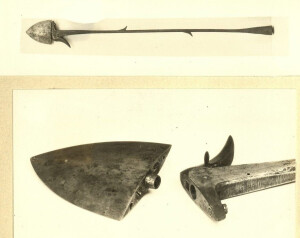 | NOTES: Freeman iron, point is missing as of April 14, 1991. This iron has a hollowed head filled with a charge of black powder which exploded after the iron entered the whale. Patented by Charles Freeman of Brewster, Massachusetts, May 7, 1872. Patent No. 126,388 This iron "had a hollowed head to be filled with gunpowder. A time fuse with a short stem was attached to the rear of the head. A percussion cap was placed on a nipple at the rear of the stem which fit into a hole in the forward part of a widened shank section that was made to form a flat base on which the head was mounted. A screw through the toe of the base secured the explosive head to the harpoon. The widened shank section also contained a firing mechanism. The hammer of the firing mechanism was a metal rod, forced against the percussion cap at the base of the head by a coil spring. A small spring-loaded latch held the hammer in the cocked position. A large pivot barb at the side of the shank opposite the screw securing the head acted as a trigger. During penetration, the resistance of the blubber pushed the pivot barb in toward the shank. This made the barb press against the latch holding the hammer, causing it to release the firing mechanism. On some examples of the Freeman iron a small safety lever was provided to prevent actuating the barb inadvertently. Most Freeman irons were made with two small stationary barbs brazed to the shank to make withdrawal more difficult and to prevent the iron from working its way out." - Lytle, Thomas G. "Harpoons and Other Whalecraft". pp. 56-57. The Old Dartmouth Historical Society. 1984 In 'The Whale Fishery and Its Appliances,' 1883, James Templeman Brown said this iron, charged with 3/4 lb. of gunpowder, was used for killing finback whales off the coast of Cape Cod in Massachusetts. Whalesite.org says this about Freeman's iron: The cast iron head of the Freeman iron was hollow and filled with gunpowder. A time fuse with a short stem was attached to the rear of the head. A percussion cap was placed on a nipple at the rear of the stem which fit into a corresponding hole in the forward part of a widened shank section. This section was made to form a flat base on which the head was mounted. A screw through the toe of the base secured the explosive head to the harpoon. The widened shank also contained the firing mechanism. The hammer of the firing mechanism was a metal rod, forced against the percussion cap at the base of the head by a coil spring. A small spring-loaded latch held the hammer in the cocked position. A large iron pivot barb at the side of the shank, opposite the screw securing the head, acted as a trigger. During penetration the resistance of the blubber pushed the pivot barb in toward the shank. This action resulted in the barb pressing against the latch holding the hammer, causing it to release the firing mechanism and exploding the head. On some examples of the Freeman iron a small safety lever was provided to prevent actuating the barb inadvertantly. Most Freeman irons were made with two small stationary barbs brazed or forge welded to the shank to make withdrawal more difficult, preventing the iron from working its way out. However, there are some examples of the Freeman iron which do not have these small shank barbs. There were several Freeman irons made, but they were never very popular, probably because the explosion would have destroyed the harpoon and its barb, and possibly would have blown the iron back out of the whale. NOTES: Clifford Warren Ashley (1881–1947) was an American artist, illustrator, author, sailor, photographer, and knot expert. Born in New Bedford, Massachusetts. He died in Westport Point, Massachusetts in 1947. He attended the Eric Pape Art School in Boston. In the summer of 1901 Ashley, along with friends N.C. Wyeth and Henry J. Peck, studied under George Noyes in Annisquam, Massachusetts. In the fall, he went on to become a student of Howard Pyle's school in Wilmington, Delaware. Ashley was a prolific painter of New England landscapes and whaling scenes but is perhaps best known for The Ashley Book of Knots (1944), an encyclopedic reference manual with directions and descriptions for and illustrations of 3,857 knots. The original manuscript of this publication is in the collection of The Mariners’ Museum. Ashley also wrote The Blubber Hunters (1906), The Yankee Whaler (1926) and The Whaleships of New Bedford (1929). The Museum’s collection holds a number of items donated or acquired from Ashley: [letters and numbers are old accession numbers] FC34 document box; FW1 water thief; IC3 ditty bag; IC4 sea bag; JO1-2 rowlocks; JP22 mariners splice; JR2.01-.02 single blocks; JR3.01-.02 double blocks; JR4 fairlead block; JR5 Jib hank; MH17 model of iceboat Flying Cloud; MH20 model of full rigged pack ship Louisa; MH21 model of tea clipper; MX1 prototype model of catboat; NR1 drawing instrument; NR2-3 parallel rules; NR4 gunter scale; NR5 parallel rule with protractor; OF36 figurehead Martha; OF53 Figurehead mermaid; paintings QO12, QO13, QO114, QO169, QO170, QO183, QO184; TC43 hood driver; TS1 plane; TS3 caulking ladle; TS4 Adze; TS5 scraper; TS6 caulk ripper; TS7 nose auger; Harpoons WH1-22, WH41; WW1 lantern keg; WW2 water bucket; WW3 piggin; YW1 baleen; and YW3 jawbone from small sperm whale. | CL7639 | |||||||
| 12 | 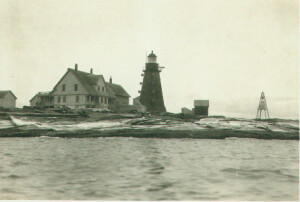 | Mount Desert Island (Me.). | on verso: Mount Desert Lighthouse, Mount Desert Rock, ME. established 1830; 58 ft. high. | Lighthouses. | Distant view of lighthouse and keepers house with water and snow in foreground. History Mount Desert Rock is the farthest land on which a New England coast lighthouse shows its warning 'light in the window.' ...A strange sight, indeed, in a strange place! rising above the waves like the last monument of some buried city of antediluvian times... A bare rock, drenched by every gale, holds the light-tower high above the waves. Far-flung Mount Desert Rock Light is one of the most dramatically isolated of all American lighthouses. More than 20 miles from the nearest port at Mount Desert Island, the low-lying, wave swept rock is, as historian Edward Rowe Snow put it, like "part of another world." George Putnam, for many years the commissioner of the Bureau of Lighthouses, regarded Mount Desert Rock as the most exposed light station in the United States. The tiny rock is only about 17 feet above sea level at its highest point. The French explorer Samuel de Champlain, during his visit to the area in 1604, named Mount Desert Rock and the much larger Mount Desert Island. The name is traditionally pronounced "dessert," like the last course of a meal. Congress appropriated $5,000 for a lighthouse on Mount Desert Rock on March 2, 1829, to aid mariners heading to Frenchman and Blue Hill Bays from the south. The light went into operation on August 25, 1830, with a fixed white light 44 feet above mean high water. Esais Preble was the first keeper and his son, William, was his assistant. The first lighthouse took the form of a short wooden tower at one end of a stone keeper's dwelling, with a system of ten lamps fueled by whale oil. The structure weathered many storms before being replaced for $15,000 by a new 58-foot granite tower in 1847. The new tower was designed by the noted architect Alexander Parris. In 1858, a new lantern was installed along with a third-order Fresnel lens exhibiting a fixed white light. A rotating fourth-order lens replaced the third-order Fresnel lens in 1898, and the characteristic was changed from fixed to a white light flashing every 15 seconds. A second dwelling, a one-and-one-half wood-frame house, was added to the station in 1876. The old stone dwelling was replaced by a wood-frame double dwelling in 1893, providing accommodations for two keepers and their families. Several new outbuildings were added around the same time, and 250 feet of planked walkways were added between the buildings. In 1853, Albert Wood, captain of the steamer Admiral, made a case for a fog bell at Mount Desert Rock. "If a bell were ringing in thick weather," he wrote, "instead of trying to avoid the rock, navigators would calculate to go within hearing distance, get a new course, and proceed up the bay with much more safety." Other local mariners agreed, and an open-frame bell tower, with a 1500-pound fog bell operated by a striking mechanism, was installed in 1856. In 1889, the Lighthouse Board made a case for a powerful fog whistle. Congress soon appropriated $4500 and the new signal was installed. A December 1878 newspaper reported on a particularly bad storm at Mount Desert Rock: Last Tuesday night there swept along the coast of Maine... one of the severest gales that has been experienced in this latitude for years. On the shores of Mount Desert and the other islands around the mouth of the Penobscot and on the main land it was very severe, and out on Mount Desert Rock it must have been terribly wild... On Wednesday evening, the night after the storm, no light was seen in the direction of the rock. Grave fears were entertained that the lighthouse had been washed away, and that the keeper and his family had perished. Thursday and Friday nights passed, and the long-looked-for light was still missing. Then the belief became general that disaster must have befallen the light-house, and it was generally supposed that the house and its inmates had sunk beneath the waves. Owing to the roughness of the sea, there could be no communication with the rock. That Saturday night a light was finally seen and it was learned that the keeper and his family had somehow weathered the storm. In Lighthouses of New England, Edward Rowe Snow told the story of an unusual wreck in the vicinity of Mount Desert Rock in the 1880s. The schooner Helen and Mary, carrying granite from Halifax, sank in a storm near the island. The captain's wife, who was also the sister of the first mate, was on board with her baby girl. When the vessel sank the first mate was able to survive by clinging to some wreckage. As he drifted the mate saw a package floating by. He snatched it from the water and found that it was his sister's baby girl wrapped in oilskin. Air trapped inside the wrapping had kept the baby afloat. The mate held the child close to him through the night and the next day the pair was picked up by the crew of the lighthouse tender Iris. In December 1902, the New York tugboat Astral, with a barge in tow, ran aground at Mount Desert Rock in a gale with 18 men aboard. The situation looked hopeless, but with the arrival of low tide Keeper Fred Robbins and an assistant (Charles H. Newman or William H. C. Dodge) managed to get close enough to the vessel to get a line aboard. All the men except one who had already frozen to death were pulled to safety. The keeper's wife prepared steaming coffee for the survivors, and salve applied to the men's freezing limbs enabled them to recover fully. The crew of the Astral remained at Mount Desert Rock until the storm subsided six days later. Meanwhile, the barge that was being towed by the tug drifted all the way to Rockland with several men safely aboard. Despite its isolation, Mount Desert Rock was for many years a family station. It became a tradition each spring for the families to bring soil to the island for a garden, and local fishermen made contributions of earth from the mainland. By the summer a beautiful flower garden would be in bloom. With luck the flowers would remain until fall, but the first gales of winter would sweep the rock clean of the last bit of dirt. One woman who grew up on Mount Desert Rock told Mary Ellen Chase, author of The Story of Lighthouses: In recent years some vegetation has survived the mild winters at the Rock The people who sailed past called it God's Rock Garden, but it was really mine. I never gave Him my garden, but I've thanked Him all my life for Mount Desert Rock. Vinal O. Beal was one of the early 20th century keepers at the station. His daughter Robina described the unusual way her parents had of making sure she and her siblings were safe when playing outside. A line was attached to Robina's waist, with the other end looped around a clothesline that extended from the house to a derrick. This way the children could not be washed away. Arthur E. Ginn was one of the keepers for a few years around 1920. Ginn lived at the station with his wife, Inez, and their three daughters. During this time, a teacher came to the station for 10 days each month. One day, while Ginn was away getting supplies, a thick fog rolled in. According to family tradition, Ginn's daughters and the children of the other keepers sounded a fog signal (probably a backup bell) for hours so that Ginn would find his way back. He got back safely with the aid of his compass. George York was keeper from 1928 to 1936. His son Wilbur was only two years old when they moved into the station. He later remembered some details of life there helping his father polish brass and lugging coal for the stove, and the excitement of monthly runs for supplies, like 50-pound sacks of flour and 25-pound tubs of peanut butter. One year after a storm the supply boat couldn't get in and the family nearly starved, living on biscuits and molasses. Wilbur's stepmother ran out of lard for biscuits the day before the supplies finally arrived. In 1931-32, a navigational radio beacon was installed at Mount Desert Rock, and generators brought electricity to the light and keeper's house. On October 6, 1962, Hurricane Daisy struck the Rock, destroying the walkway between the house and tower, as well as sweeping away fuel tanks and other structures. The three Coast Guardsmen there at the time spent the night near the top of the lighthouse tower. One of the men, John Baxter, said later: The bad thing was that when we went in the tower you could feel the tower sway, like someone was shaking it. It was scary! The next morning, when things calmed down, we went outside the tower. We had an engine room, probably 90 feet by 90 feet. And it was gone. Crushed. A boulder had rolled up onto the bank and just crushed it. That was really scary then, because we got thinking. What if that boulder had hit that tower? It would've knocked that over, or done a good job on it. There's no way we would've survived it. In spite of the arrival of modern conveniences like television, life for Coast Guard keepers at Mount Desert Rock wasn't much easier than it had been for Lighthouse Service keepers. 20-year-old Douglas Nute, a native of St. Louis, told author Bill Caldwell that he was "ready to scream" after a week at the station. Nute had previously been stationed on Great Duck Island; there, at least, were trees and grass and some space to walk around. In the mid-1970s the Coast Guard removed the lantern of Mount Desert Rock Light to make room for rotating aerobeacons. A combination of public complaints and storm damage to the aerobeacons convinced the Coast Guard to install a new lantern in 1985. The Coast Guard crew constructed a helicopter pad in the mid-1970s. "It took one good storm to wipe it out," says Glenn Gearheart. "There was nothing like watching waves washing over the whole island. We were in the lighthouse. The whole island was vibrating." Courtesy of Glenn Gearheart The last Coast Guard keepers were removed by helicopter in late 1977. The light station was then leased to Bar Harbor's College of the Atlantic for use as a whale watching station. The college's Allied Whale program compiles and maintains catalogs for the North Atlantic populations of finback and humpback whales. More than 4,000 individual humpback whales and 500 finbacks have been cataloged by the group. Researcher Tim Cole told the Christian Science Monitor in 1988: I like to get up into the tower maybe a half-hour before sunrise. As the sky lightens, things gradually start to happen more birds fly by, or a few whales become visible. You can sit and watch as the world starts to move. The generator shed. The College of the Atlantic replaced the roof of the dwelling in 2000. A building formerly used as a generator house was turned into a marine lab. The lighthouse is best seen by private boat or from the air, although whale watches from Bar Harbor occasionally pass near Mount Desert Rock. Inside the base of the tower. August 29, 2009: According to this article, Mount Desert Rock suffered badly from the effects of Hurricane Bill. The boathouse was mostly destroyed, and two walls of the generator shed were swept away. There was also water damage inside the keeper's house. This is a major setback for the College of the Atlantic's programs on the island. As Andrew Peterson, marine facilities superintendent for the college, aptly put it, "When it comes down to it, the ocean always wins." Keepers: Esais Preble (1833-1835); Benjamin Ward Jr. (1841-?); Jacob L. Richardson (1848-1850); David King (1850-1853); Rufus King (1853-1859); George Booth (1859-1860); Joseph Hopkins (1860-1861); William E. Holden (1861-1864); Seth H. Higgins (assistant 1864-1865, principal keeper 1865-1867); J. A. Williken (1867-1868); Otis W. Kent (1868-1872); Amos B. Newman (1872-1881); James A. Morris (1881-1882); Thomas R. Milan (or Mylan) (1882-1902); Fred M. Robbins, second assistant (1898-1899), then first assistant (1899-1902) then principal keeper (1902-1911); Vinal O. Beal, second assistant (1909-1910), first assistant (1910-1911), then principal keeper (1911-c. 1918); Arthur Edward Ginn (c. 1918-early 1920s); R. W. Powers (c. 1928); George York (1928-1936); Robert G. Wass (c. 1930s); Jarvis Barnett (Coast Guard officer in charge, c. 1946-1948); Ralph Demons (or Demmons) (c. 1948-?) Assistant keepers: William Preble (1833-1835); William H. Ward (1855-1858); John Dolliver Jr. (1858-1859); B. Thurber (1859-1864); David Rollins (1865-1867); Dan Ladd (1865); William Gilley (1867); Dan B. Eaton (1867-1871); Perry W. Richardson (1868-1870 and 1871-1872); Amos B. Newman (1870-1872); Mark W. Hodgson, (1872-1882); William P. Sawyer, second assistant (1872-1878); James A. Morris (1874-1876); Frank Collins (1876-1877); Howard P. Robbins, second assistant (1878-1882); William Stanley, assistant (1882-1883); Benjamin Maddox (1883-1888); Howard M. Gilley, second assistant (1883-1887); Lewis F. Sawyer, second assistant (1887-1888), then first assistant (1888-1889); Willis Dolliver, second assistant (1887-1890), then first assistant (1890-1891); William J, Newman, second assistant (1890), then first assistant (1890); Thomas R. Savage, second assistant (1891-1892); Orrin L. Milan, second assistant (1892-1895), then first assistant (1895-1897); Charles Thurston, second assistant (1895-1897), then first assistant (1897-1899); Joseph M. Gray (1900-1901); Bert Richard (c. 1901); Herbert P. Richardson, second assistant (c. 1902); Charles H. Newman (c. 1902-1908); William H. C. Dodge, second assistant (c. 1902-1908); W. P. Kent (1909-1910); Wilbert F. Lurney (or Lurvey?) second assistant (1910), then first assistant (1911-?); Charles A. Radley, second assistant (1911-?); Joseph Muise (c. 1920s); A. H. Kennedy (c. 1932); Everett Quinn, assistant (c. 1935); H. C. Day, assistant (c. 1935); M. J. Hergatt (Coast Guard, c. 1948); H. B. Clement (Coast Guard, c. 1948); John Baxter (Coast Guard, c. 1962); Douglas Nute (Coast Guard, c. 1970s); Gary L. Crossman (Coast Guard, 1973-1974); Glenn Gearhart (Coast Guard, 1974-1975). | MS0190/01-01.35#17 | ||||
| 13 | 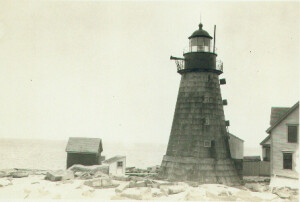 | Mount Desert Island (Me.). | on verso: Mount Desert Lighthouse, Mount Desert Rock, ME. established 1830; 58 ft. high. | Lighthouses. | Distant view of lighthouse and keepers house with water and snow in foreground. History Mount Desert Rock is the farthest land on which a New England coast lighthouse shows its warning 'light in the window.' ...A strange sight, indeed, in a strange place! rising above the waves like the last monument of some buried city of antediluvian times... A bare rock, drenched by every gale, holds the light-tower high above the waves. Far-flung Mount Desert Rock Light is one of the most dramatically isolated of all American lighthouses. More than 20 miles from the nearest port at Mount Desert Island, the low-lying, wave swept rock is, as historian Edward Rowe Snow put it, like "part of another world." George Putnam, for many years the commissioner of the Bureau of Lighthouses, regarded Mount Desert Rock as the most exposed light station in the United States. The tiny rock is only about 17 feet above sea level at its highest point. The French explorer Samuel de Champlain, during his visit to the area in 1604, named Mount Desert Rock and the much larger Mount Desert Island. The name is traditionally pronounced "dessert," like the last course of a meal. Congress appropriated $5,000 for a lighthouse on Mount Desert Rock on March 2, 1829, to aid mariners heading to Frenchman and Blue Hill Bays from the south. The light went into operation on August 25, 1830, with a fixed white light 44 feet above mean high water. Esais Preble was the first keeper and his son, William, was his assistant. The first lighthouse took the form of a short wooden tower at one end of a stone keeper's dwelling, with a system of ten lamps fueled by whale oil. The structure weathered many storms before being replaced for $15,000 by a new 58-foot granite tower in 1847. The new tower was designed by the noted architect Alexander Parris. In 1858, a new lantern was installed along with a third-order Fresnel lens exhibiting a fixed white light. A rotating fourth-order lens replaced the third-order Fresnel lens in 1898, and the characteristic was changed from fixed to a white light flashing every 15 seconds. A second dwelling, a one-and-one-half wood-frame house, was added to the station in 1876. The old stone dwelling was replaced by a wood-frame double dwelling in 1893, providing accommodations for two keepers and their families. Several new outbuildings were added around the same time, and 250 feet of planked walkways were added between the buildings. In 1853, Albert Wood, captain of the steamer Admiral, made a case for a fog bell at Mount Desert Rock. "If a bell were ringing in thick weather," he wrote, "instead of trying to avoid the rock, navigators would calculate to go within hearing distance, get a new course, and proceed up the bay with much more safety." Other local mariners agreed, and an open-frame bell tower, with a 1500-pound fog bell operated by a striking mechanism, was installed in 1856. In 1889, the Lighthouse Board made a case for a powerful fog whistle. Congress soon appropriated $4500 and the new signal was installed. A December 1878 newspaper reported on a particularly bad storm at Mount Desert Rock: Last Tuesday night there swept along the coast of Maine... one of the severest gales that has been experienced in this latitude for years. On the shores of Mount Desert and the other islands around the mouth of the Penobscot and on the main land it was very severe, and out on Mount Desert Rock it must have been terribly wild... On Wednesday evening, the night after the storm, no light was seen in the direction of the rock. Grave fears were entertained that the lighthouse had been washed away, and that the keeper and his family had perished. Thursday and Friday nights passed, and the long-looked-for light was still missing. Then the belief became general that disaster must have befallen the light-house, and it was generally supposed that the house and its inmates had sunk beneath the waves. Owing to the roughness of the sea, there could be no communication with the rock. That Saturday night a light was finally seen and it was learned that the keeper and his family had somehow weathered the storm. In Lighthouses of New England, Edward Rowe Snow told the story of an unusual wreck in the vicinity of Mount Desert Rock in the 1880s. The schooner Helen and Mary, carrying granite from Halifax, sank in a storm near the island. The captain's wife, who was also the sister of the first mate, was on board with her baby girl. When the vessel sank the first mate was able to survive by clinging to some wreckage. As he drifted the mate saw a package floating by. He snatched it from the water and found that it was his sister's baby girl wrapped in oilskin. Air trapped inside the wrapping had kept the baby afloat. The mate held the child close to him through the night and the next day the pair was picked up by the crew of the lighthouse tender Iris. In December 1902, the New York tugboat Astral, with a barge in tow, ran aground at Mount Desert Rock in a gale with 18 men aboard. The situation looked hopeless, but with the arrival of low tide Keeper Fred Robbins and an assistant (Charles H. Newman or William H. C. Dodge) managed to get close enough to the vessel to get a line aboard. All the men except one who had already frozen to death were pulled to safety. The keeper's wife prepared steaming coffee for the survivors, and salve applied to the men's freezing limbs enabled them to recover fully. The crew of the Astral remained at Mount Desert Rock until the storm subsided six days later. Meanwhile, the barge that was being towed by the tug drifted all the way to Rockland with several men safely aboard. Despite its isolation, Mount Desert Rock was for many years a family station. It became a tradition each spring for the families to bring soil to the island for a garden, and local fishermen made contributions of earth from the mainland. By the summer a beautiful flower garden would be in bloom. With luck the flowers would remain until fall, but the first gales of winter would sweep the rock clean of the last bit of dirt. One woman who grew up on Mount Desert Rock told Mary Ellen Chase, author of The Story of Lighthouses: In recent years some vegetation has survived the mild winters at the Rock The people who sailed past called it God's Rock Garden, but it was really mine. I never gave Him my garden, but I've thanked Him all my life for Mount Desert Rock. Vinal O. Beal was one of the early 20th century keepers at the station. His daughter Robina described the unusual way her parents had of making sure she and her siblings were safe when playing outside. A line was attached to Robina's waist, with the other end looped around a clothesline that extended from the house to a derrick. This way the children could not be washed away. Arthur E. Ginn was one of the keepers for a few years around 1920. Ginn lived at the station with his wife, Inez, and their three daughters. During this time, a teacher came to the station for 10 days each month. One day, while Ginn was away getting supplies, a thick fog rolled in. According to family tradition, Ginn's daughters and the children of the other keepers sounded a fog signal (probably a backup bell) for hours so that Ginn would find his way back. He got back safely with the aid of his compass. George York was keeper from 1928 to 1936. His son Wilbur was only two years old when they moved into the station. He later remembered some details of life there helping his father polish brass and lugging coal for the stove, and the excitement of monthly runs for supplies, like 50-pound sacks of flour and 25-pound tubs of peanut butter. One year after a storm the supply boat couldn't get in and the family nearly starved, living on biscuits and molasses. Wilbur's stepmother ran out of lard for biscuits the day before the supplies finally arrived. In 1931-32, a navigational radio beacon was installed at Mount Desert Rock, and generators brought electricity to the light and keeper's house. On October 6, 1962, Hurricane Daisy struck the Rock, destroying the walkway between the house and tower, as well as sweeping away fuel tanks and other structures. The three Coast Guardsmen there at the time spent the night near the top of the lighthouse tower. One of the men, John Baxter, said later: The bad thing was that when we went in the tower you could feel the tower sway, like someone was shaking it. It was scary! The next morning, when things calmed down, we went outside the tower. We had an engine room, probably 90 feet by 90 feet. And it was gone. Crushed. A boulder had rolled up onto the bank and just crushed it. That was really scary then, because we got thinking. What if that boulder had hit that tower? It would've knocked that over, or done a good job on it. There's no way we would've survived it. In spite of the arrival of modern conveniences like television, life for Coast Guard keepers at Mount Desert Rock wasn't much easier than it had been for Lighthouse Service keepers. 20-year-old Douglas Nute, a native of St. Louis, told author Bill Caldwell that he was "ready to scream" after a week at the station. Nute had previously been stationed on Great Duck Island; there, at least, were trees and grass and some space to walk around. In the mid-1970s the Coast Guard removed the lantern of Mount Desert Rock Light to make room for rotating aerobeacons. A combination of public complaints and storm damage to the aerobeacons convinced the Coast Guard to install a new lantern in 1985. The Coast Guard crew constructed a helicopter pad in the mid-1970s. "It took one good storm to wipe it out," says Glenn Gearheart. "There was nothing like watching waves washing over the whole island. We were in the lighthouse. The whole island was vibrating." Courtesy of Glenn Gearheart The last Coast Guard keepers were removed by helicopter in late 1977. The light station was then leased to Bar Harbor's College of the Atlantic for use as a whale watching station. The college's Allied Whale program compiles and maintains catalogs for the North Atlantic populations of finback and humpback whales. More than 4,000 individual humpback whales and 500 finbacks have been cataloged by the group. Researcher Tim Cole told the Christian Science Monitor in 1988: I like to get up into the tower maybe a half-hour before sunrise. As the sky lightens, things gradually start to happen more birds fly by, or a few whales become visible. You can sit and watch as the world starts to move. The generator shed. The College of the Atlantic replaced the roof of the dwelling in 2000. A building formerly used as a generator house was turned into a marine lab. The lighthouse is best seen by private boat or from the air, although whale watches from Bar Harbor occasionally pass near Mount Desert Rock. Inside the base of the tower. August 29, 2009: According to this article, Mount Desert Rock suffered badly from the effects of Hurricane Bill. The boathouse was mostly destroyed, and two walls of the generator shed were swept away. There was also water damage inside the keeper's house. This is a major setback for the College of the Atlantic's programs on the island. As Andrew Peterson, marine facilities superintendent for the college, aptly put it, "When it comes down to it, the ocean always wins." Keepers: Esais Preble (1833-1835); Benjamin Ward Jr. (1841-?); Jacob L. Richardson (1848-1850); David King (1850-1853); Rufus King (1853-1859); George Booth (1859-1860); Joseph Hopkins (1860-1861); William E. Holden (1861-1864); Seth H. Higgins (assistant 1864-1865, principal keeper 1865-1867); J. A. Williken (1867-1868); Otis W. Kent (1868-1872); Amos B. Newman (1872-1881); James A. Morris (1881-1882); Thomas R. Milan (or Mylan) (1882-1902); Fred M. Robbins, second assistant (1898-1899), then first assistant (1899-1902) then principal keeper (1902-1911); Vinal O. Beal, second assistant (1909-1910), first assistant (1910-1911), then principal keeper (1911-c. 1918); Arthur Edward Ginn (c. 1918-early 1920s); R. W. Powers (c. 1928); George York (1928-1936); Robert G. Wass (c. 1930s); Jarvis Barnett (Coast Guard officer in charge, c. 1946-1948); Ralph Demons (or Demmons) (c. 1948-?) Assistant keepers: William Preble (1833-1835); William H. Ward (1855-1858); John Dolliver Jr. (1858-1859); B. Thurber (1859-1864); David Rollins (1865-1867); Dan Ladd (1865); William Gilley (1867); Dan B. Eaton (1867-1871); Perry W. Richardson (1868-1870 and 1871-1872); Amos B. Newman (1870-1872); Mark W. Hodgson, (1872-1882); William P. Sawyer, second assistant (1872-1878); James A. Morris (1874-1876); Frank Collins (1876-1877); Howard P. Robbins, second assistant (1878-1882); William Stanley, assistant (1882-1883); Benjamin Maddox (1883-1888); Howard M. Gilley, second assistant (1883-1887); Lewis F. Sawyer, second assistant (1887-1888), then first assistant (1888-1889); Willis Dolliver, second assistant (1887-1890), then first assistant (1890-1891); William J, Newman, second assistant (1890), then first assistant (1890); Thomas R. Savage, second assistant (1891-1892); Orrin L. Milan, second assistant (1892-1895), then first assistant (1895-1897); Charles Thurston, second assistant (1895-1897), then first assistant (1897-1899); Joseph M. Gray (1900-1901); Bert Richard (c. 1901); Herbert P. Richardson, second assistant (c. 1902); Charles H. Newman (c. 1902-1908); William H. C. Dodge, second assistant (c. 1902-1908); W. P. Kent (1909-1910); Wilbert F. Lurney (or Lurvey?) second assistant (1910), then first assistant (1911-?); Charles A. Radley, second assistant (1911-?); Joseph Muise (c. 1920s); A. H. Kennedy (c. 1932); Everett Quinn, assistant (c. 1935); H. C. Day, assistant (c. 1935); M. J. Hergatt (Coast Guard, c. 1948); H. B. Clement (Coast Guard, c. 1948); John Baxter (Coast Guard, c. 1962); Douglas Nute (Coast Guard, c. 1970s); Gary L. Crossman (Coast Guard, 1973-1974); Glenn Gearhart (Coast Guard, 1974-1975). | MS0190/01-01.35#18 | ||||
| 14 | 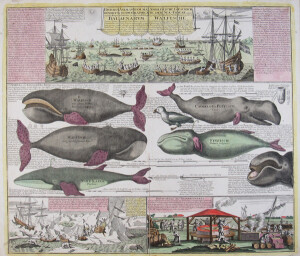 | NOTES: Hand-colored engraving titled 'Historia Animantium Marinorum Iconographica...' published by the Homann Heirs in the mid 18th century. There are four sections on the plate: 1. Whaling scene in Arctic., 2. Six types of whales, a sea louse, sea worms, a sea bird and several harpoons., 3. Whaleships trapped in the ice., 4. Try-works on shore. Each illustration is accompanied by a lengthy description in Dutch. The images are drawn from the writings of whalers Friderich Martens (1635-1699) who published 'Spitzbergische oder Groenlandische Reise-Beschreibung, gethan im Jahre 1671' in 1675 and Cornelius Gisbert Zordrager (ca 1660-1720) who published 'Beschreibung des Gronlandischen Walfischfang' in 1750. 'Cum Privilegio S. Caef. Maj. Gratiosissimo,' under the title, is a Latin legal phrase meaning "with the most gracious privilege of His Sacred Imperial Majesty". It indicated that the Holy Roman Emperor granted the publisher legal protection against unauthorized copying. NOTES: [Description from page 228 of Whaling Prints in the Francis B. Lothrop Collection by Elizabeth Ingalls] From: Natur-und Kunstatlus, Nuremberg: Homann heirs, ca. 1760. Herauugegeben in der Homaennischen Handlung A. 1752. (published by the Homann booksellers in 1752.)] *The Homann family were prolific mapmakers and publishers in Nuremberg from 1702 to 1813. The family firm was established by Johann Baptist (1663-1724), then carried on by his heirs. Variations in the spelling of Homann occur in Spanish, French, and Latin. There are 3 known Homann prints showing whales and whaling scenes. The other two were published as a pair illustrating the natural history of the animal. (LE 330 and LE 331) [Translation of title panel] (...particularly the whale. First a special introduction in which the whales are pictured before you, according to their species, figure, size, feeding, capture of the whales, the preparation of the whalebone and blubber, and other curious happenings in the Polar Sea. All is extracted from the valuable book of travels of Fr. Martens, Zordrager, etc. and published for the amusement of nature lovers and contributed by the Homann heirs. With the gracious permission of his sacred majesty.) Four Sections: [top:] Beschreibung des Wallfisch-Fangs...(Description of the whale fishery). This scene is a copy of Plate A of Martens 1675 (Ingall's, Cat. 137). It is keyed a-r, differently from the original Martens plate, with the explanations on the side panels. [center:] Die Walfische oder Eilaendische Fische...(The Whales or island [Spitsbergen] fish). The three whales on the left, the whale louse, sea worms, lance, and harpoon are all from Pl. Q of Martens, (Ingall's, cat. 445). The three whales on the right are from Zorgdrager 1720, pp. 7, 81, and 162 (Ingall's, cat. 373, 374, 375). These have not been copied exactly, however, as the taxonomy is rather confused and incorrect. A Nord Kaper is a right whale, not a Physeter (sperm whale). And a Finfisch is the fin or finback, Balaenoptera physalus, not Balaena vulgaris, which is the common, bowhead, or right whale and does not have a dorsal fin. [lower left:] Weil die Walfisch sich gern unter die Eis-Felder...(Because the whales like to hide under the ice fields, the ships have to sail on the ice). This scene depicting the ships caught in the ice is a copy of Pl. B of Martens, 1675 (Ingall's cat. 137). [lower right:] Beschreibung der Tranbrennerey...(Description of the tryworks). The blubber is packed in barrels in the arctic to be dried out upon the return home. This scene, possibly of Hamburg, is from neither Martens or Zorgdrager. ROUGH TRANSLATION: [Panel 1] (at top center of title panel in Latin and German) Illustrated history of sea animals particularly the whale. First a special introduction in which the whales are pictured before you, according to their species, figure, size, feeding, capture of the whales, the preparation of the whalebone and blubber, and other curious happenings in the Polar Sea. All is extracted from the valuable book of travels of Fr. Martens, Zordrager, etc. and published for the amusement of nature lovers and contributed by the Homann heirs.; (key panel at top left) Description of the whale hunt: a) There are large ice fields. The sea ice is not smooth and has a color resembling blue vitriol. (b) One sails in between the large ice fields, secures the ships to them, and (c) posts lookouts. (d) When a whale is spotted, it is pursued in shallops. (e) The harpooner throws the harpoon at the whale; this is often done from two shallops. The harpoon is thrown—whenever possible—at the blowholes, and the action is often repeated two or three times. (f) The harpoon is attached to a line that runs back to the shallop, where (g) it can be paid out or hauled in by the line-handler in the line-well, as necessity dictates. (h) When the whale realizes it has been struck, it dives toward the ocean floor; the harpooner must then check if the line is being pulled too taut—so that it can be slackened—to prevent the entire shallop from being dragged down by the whale, which rushes away with great speed. (i) If the line goes slack, however, the line-handler must haul it in, taking care that it does not become tangled. (k) If the whale is not properly struck by the harpoon, it raises its tail and escapes. Consequently, the best time to strike is when it is spouting water, as it cannot hear anything at that moment. (l) The whale also escapes if it swims beneath an ice field for several miles, as the line must then be cut, forcing one to abandon the whale along with the harpoon and line. (m) The whale wounded by the harpoon; (at top on left side of image panel) A ship 110 to 118 feet in length. It must be very sturdily built—more so than other ships—due to the danger posed by the ice; it carries 50 harpoons and an equal number of lances, along with 60 whale lines, each 125 fathoms long and weighing 75 to 80 pounds. Each such ship carries 47 shallops (X), each manned by a crew of 28 to 50 men. Upon completion of the whaling voyage, a ship's cargo amounts to 600, 700, or even 800 Quartelen of blubber. The ship and its shallops are collectively referred to as a Fluyt.; (key panel at top right) After having turned the water completely bloody and exhausted himself by thrashing about, he rises again from the depths and is stabbed to death with lances (n). The steersman must constantly control the shallop and keep the harpoon line taut (o). The dead whale’s tail is cut off, and it is towed to the large ship by four or more shallops (M)—a process known as towing. Here, it is lashed to the ship, and the "cant piece" (a large strip of blubber) is first stripped down from the head. Once detached all around, this strip of blubber extends from the water below up to the crow's nest, allowing one to estimate the whale's thickness (p). The whale is hoisted upward, suspended by a strip of blubber attached to the crow's nest, while simultaneously being wound further up as more blubber is removed; the blubber is then cut by the "blubber-cutters" into distinct pieces, each half an ell in length. These pieces are cut into smaller sections on a table and packed into barrels or casks. Once all the blubber has been removed, the baleen is also hoisted up in one piece to be cleaned and cut back home. The remaining carcass is left to the scavenging birds (q); this refers to a fatty substance the whale sometimes exhales, which is consumed by fulmars (r). Fulmars often appear in such great numbers that they can be beaten to death with sticks.; [Panel 2 at middle, text from left to right and top to bottom] (at top left corner) Whales—or "island-sized fish"—do not spawn; instead, they give birth to two or three young, which they suckle with milk. During mating, they raise their heads out of the water; possessing very hot blood, they seek out cold regions—specifically latitudes between 70 and 80 degrees. They have a layer of yellow blubber six to twelve thumbs thick, and a layer an ell thick on the underbelly and beneath the lips—enough to fill 50 to 80 Quartelen (casks holding two Eimer each). Leeuwenhoek speculates that these creatures can live for a thousand years or more.; (on whale at top left of panel) (a) Whale with open gullet (Balaena propria); (at top of panel to left of center around image of sea louse) A whale louse—a creature resembling a sea crab—lodges itself between the fish's lips, fins, and genitals, biting out entire chunks of skin.; (at top of panel at right) (g) The sperm whale lacks baleen but is equipped with teeth. It inhabits the waters of the Indies and is notable because spermaceti—a substance once mistakenly thought to be whale semen—is derived from its massive head. In 1723, twenty-one of these whales strayed into the Elbe River; a large quantity of spermaceti was subsequently produced from their brains. Scale: 42 Rhenish feet. (under scale); (at top right corner of panel) tooth of a pot fish, 52 of which are found in the lower jaw. (over tooth), ½ Rhenish feet. (to right of scale); (at top center of panel over bird) A seabird known as the *Mallemucke* lives off whale blubber in the waters of Spitsbergen—whether from a dead or a living whale—and its presence often betrays the whale's location. It gorges itself until it collapses. It croaks like a frog. Its back and wings are gray, while its head and belly are white.; (on whale at top right) Sperm whale (Cetacean) (g); (under tail of whale at top left) (b) Here the fish blows water out of two bladder holes, so that it roars like a roaring wind, and can be heard for a mile. This roaring is even more terrifying when it is wounded, in which case it also bleeds out its own blood.; (to left of whale at center left) (d) The tail is 3 to 4 class wide. It lashes out powerfully when it feels rough, and also when it is speared, so that the boats have to be very careful not to be hit and shattered into a thousand pieces. The tail and fins are marbled, the skin of the rest of the body is blackish and smooth, white under the belly.; (over tail of whale at center left, discussing worms) (c) Sea worms, etc. The carcasses of whales, which he swallows at once in the thousands, are unsalted, fatty, and taste like fish oil. He also needs much other such small debris for his diet.; (on whale at center left) WHALE with closed mouth; (over whale at center right) (h) The fin whale is as long as the right whale but not as thick; it is faster in its movements and therefore more dangerous to catch. The fins on its back distinguish it from the right whale. Like the right whale, it spouts water from its blowholes, but with greater force. Because it does not yield enough blubber, it is not hunted extensively. Its upper jaw is also lined with baleen. Its diet differs from that of the right whale, consisting mainly of herring and cod. Its blood is not as warm as that of right whales, and it does not frequent the extremely cold waters near the poles, preferring instead to inhabit somewhat more distant and warmer waters.; (on whale at center right) FIN FISH (Balæna vulgaris) (h); (under tail of whale at center left) (a) The eye of the whale is no larger than that of an ox and is furnished with eyebrows. During dissection, Leeuwenhoek found it surrounded by a firm substance and concluded that this was necessary due to the immense pressure of the water; for calculations show that with a water column 8,400 feet high—the depth to which a whale often dives—each cubic foot of seawater (weighing 66 lbs) would be subjected to the pressure of 554,400 lbs of water, meaning the eye would have to withstand a load of 23,200 lbs. The horny skin could be separated into 18 distinct layers.; (at center over scale and harpoon) Scale for the fin-fish of 54 Rhenish feet; a lance 2 fathoms or 12 feet long.; (under body of whale at center right and over scale) (i) Open mouth of a whale, showing the arrangement of the baleen plates.; (on whale at bottom left corner) North Atlantic right whale (Physter) (e); (under whale at bottom left corner) (e) This fish frequents the waters off the North Atlantic and Iceland, seeks the deepest water, and feeds on herring, cod, and similar fish. It is of a colder nature than the whale; furthermore, instead of teeth, it has baleen plates in its mouth extending down to the throat.; (at bottom center above and below harpoon) A harpoon with its wooden shaft, which is attached to the socket (l). The shaft or pole is 8 or 10 feet long. This leading rope (k) is made of the finest hemp and is 36 feet long; it is called the "forerunner," and the whale line is attached to both its ends. About 14 sections of line are used—that is, a rope 1,400 fathoms (or 8,400 feet) long—to allow slack for the whale as it dives toward the ocean floor.; (to left of whale mouth at bottom right corner) The baleen plates are situated in the upper lips and throat, extending down to the gullet. These plates are broad, long, horny strips, fringed with hair at their ends. There are about 500 of them on each side, the largest measuring 10 to 12 feet in length. It is from these plates that the baleen is cut and whalebone prepared; together with the gums, they weigh 1,200 pounds. They serve the fish in place of teeth, ensuring that when the mouth closes, the water scooped up with the prey drains away while the prey itself is retained. The hairs on the plates protect the tongue from any injury caused by the plates themselves.; [Panel 3, bottom left corner] (at top center) Because whales like to hide beneath ice fields and floes, ships must sail into the ice; however, during a storm, the floes pile up upon one another (A) to such an extent that they stand like mountains. Consequently (B), a ship is often crushed by them—or even pulled underwater—forcing the crew to flee onto the ice fields (C). The ice extends as far as the eye can see across the sea (D). A polar bear stands atop a dead whale alongside fulmars, feeding on the carcass.; (at top right corner) A piece of ice measuring two or more miles in length is called a "field." Ice floes smaller than two miles across are known as "fladen" (floes); smaller ones still are called "schotzen" or simply loose ice. When a whale dives beneath the large ice fields, it must soon resurface to breathe, making the hunt proceed successfully; conversely, among the floes and smaller fragments, there are many openings where the whale can more easily elude its enemies.; [Panel 4, bottom right corner] Description of the TRYWORKS. When the whale blubber has been brought to the blubber distillery in quarters, the pieces of blubber (a), cut into finlets in Greenland, are placed in the copper pan (b) and stirred while boiling (c) until, after 3 hours of boiling, the fat can be scooped out with spoons. This fat runs down the canal into the trough (d) equipped with a grate, from where it flows into two other troughs filled with 1/3 water and cools. From the alfalfa, the cooper fills it into the barrels (e). One whale yields 45-50 such quarters of blubber.; NOTES: The Homann family were prolific mapmakers and publishers in Nuremberg from 1702 to 1813. The family firm was established by Johann Baptist (1663-1724), then carried on by his heirs. Variations in the spelling of Homann occur in Spanish, French, and Latin. There are 3 known Homann prints showing whales and whaling scenes. Two were published as a pair illustrating the natural history of the animal (see LE 330 and LE 331) titled Historia Animantium Marinorum Iconographica in 1752. NOTES: Nantucket native William F. Macy learned the printer’s trade at Nantucket’s newspaper, ‘The Inquirer and Mirror.’ After going to the mainland he worked in several printing shops around Boston and was appointed as the first instructor in printing at the Lyman School for Boys in Westboro, Massachusetts. Later Macy opened an insurance agency in Boston. Throughout this time he continued studying Nantucket history and frequently contributed articles to ‘The Inquirer and Mirror’ (signing his articles "Yorick"). Around 1912, in collaboration with Anna Gardner Fish and Roland Bunker Hussey, Macy issued the first edition of the "Nantucket Scrap Basket". He arranged for a second edition of this publication in 1932. In 1915, Mr. Macy prepared and published "The Story of Old Nantucket," a condensed history of Nantucket (reprinted in 1931). He was a founder and one time president of "The Sons and Daughters of Nantucket." In 1924, Macy was appointed President of the Nantucket Historical Association and served until his death in 1935. During this time Edward F. Sanderson approached the Association about receiving his collection of whaling paraphernalia with the purpose of establishing a whaling museum on Nantucket. When he returned to Nantucket in 1928 Mr. Macy purchased the old American House property, on the corner of Orange Street and Martins Lane, and built the house now standing there. This became Macy’s headquarters during his decade of planning, raising money and finally establishing the Nantucket Whaling Museum which opened its doors on July 24, 1930. NOTE: There is one (1) unaccessioned duplicate. | CL10726 |
Created 2026 by Don Barker, CBMM volunteer, for the Chesapeake Shipbuilding Project. shipbuilding@sailingworkboats.es